
Research
Research Interests
Capital Markets · Human Capital · Public Finance · Corporate Finance
Working Papers
[1] “When Automation Meets Accountability: International Evidence from Robotics Adoption and ESG Incidents”
with Sadok El Ghoul, Summer Liu, and Omrane Guedhami
Abstract
We examine whether the adoption of automation technologies influences environmental, social, and governance (ESG) risk in an international setting. Using global industrial robotics data as a proxy for automation and ESG incident measures as a proxy for ESG risk, we find that robotics stock and flow are positively associated with higher firm-level ESG risk, including the frequency of ESG incidents, overall ESG risk index, and severity, reach, and novelty of these incidents. The effect is more pronounced for environmental and social incidents. Using fixed internet broadband subscriptions and population aging measures as instruments, we establish a causal link between automation adoption and increased ESG risk. We further provide evidence that firm-, country-, and industry-level factors can moderate this relationship. Our findings highlight an important yet often overlooked downside of automation—its potential to exacerbate ESG risks and impede corporate sustainability efforts. These results also underscore the importance of integrating ESG risk management into corporate technology transformation strategies.
Conference Presentations:
- SFA Annual Meeting, 2026 (Scheduled)
- MRS International Risk Conference, 2026
- American Accounting Association (AAA) Annual Meeting, 2026
- CICF – China International Conference in Finance, Hong Kong, 2026
- FMA (Europe) Annual Meeting, 2026
- SWFA Annual Meeting, 2026
- Chicago Booth International Behavioral Finance Conference, 2025
- FMA Annual Meeting, 2025
- University of Richmond Seminar, 2025
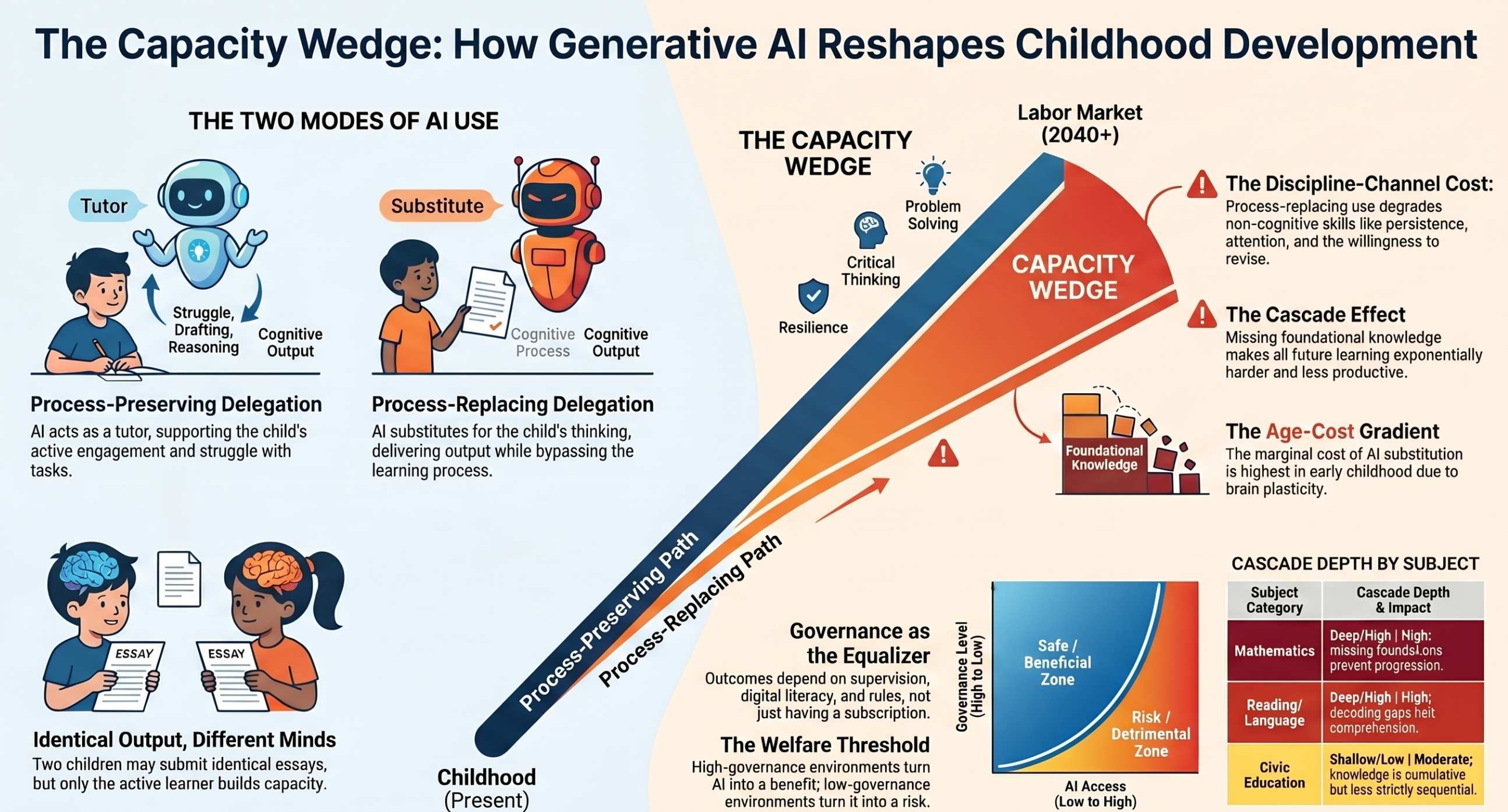
[2] “Cognitive Delegation in Childhood: A Theory of Skill Formation under Generative AI”
with Naying Zhou PDF 💡 Research Brief
Abstract
This paper develops a dynamic theory of childhood human-capital formation when a generative technology permits the production of educational output without the underlying cognitive process. We call such uses cognitive delegation and distinguish process-preserving use (active engagement above the capacity-formation threshold) from process-replacing use. The model is a discrete-time skill-formation framework in which a present-biased child accumulates knowledge, discipline, and judgment through effort, delegation, and verification, with age-dependent plasticity and a governance function setting the threshold. Solving the recursive problem under sophisticated quasi-hyperbolic preferences, we establish the Capacity-Wedge Decomposition: the long-run capacity wedge under process-replacing use admits an additive decomposition into a contemporaneous discipline-channel cost and a cascade cost from downstream knowledge complementarities. The marginal welfare cost is strictly decreasing in age, and under sufficient conditions admits a sharp threshold in governance, strictly increasing in AI capability. The framework identifies governance, not access, as the operative variable in the developmental effect of generative AI.
A picture is worth more than a thousand equations.
[3] “The Legibility Premium: Public Data Visibility and the Allocation of Competitive Federal Grants”
with Xiaoyang Zhu PDF
Not all counties are equally visible to the federal government.
[4] “Tax Cuts and Missing Jobs”
with Bei Gao, Kun Yang, Lihuan Chen, and Xiaoyang Zhu
Abstract
Conventional wisdom holds that tax incentives boost employment by lowering costs and stimulating expansion. However, a puzzling divergence emerged in China after the mid-2010s: despite intensified tax incentives, aggregate firm employment declined. Exploiting China's 2016 strategic initiative to accelerate AI adoption as a quasi-natural experiment, we investigate how AI reshapes the employment effects of tax policy. Using panel data from Chinese A-share listed firms (2011–2021) and employing robust identification strategies, we find evidence that increased tax incentives reduce overall labor demand in the AI-intensive era, leading to an estimated loss of 26,771 to 44,605 jobs, based on the employment size of listed firms. This counterintuitive effect arises as firms reallocate tax savings toward investments in AI and robotics, fostering capital-labor substitution. Moreover, the negative employment impact is particularly pronounced among firms with higher capital intensity, pessimistic management outlooks, and within service sectors. Tax incentives also induce significant labor restructuring: decreasing demand for bachelor's degree holders while increasing demand for Masters and PhDs, and shrinking non-R&D employment while boosting R&D hiring. Our findings provide novel insights into the unintended labor market consequences of fiscal policy amid technological disruption and underscore the need for adaptive fiscal policy design attuned to emerging technologies.
Publications
[1] “Share pledging and stock price synchronicity: Evidence from China” DOI
with Yanbo Jin and Jian Xu
Emerging Markets Review, 101258, 2025
[2] “Kick the cat? Retail investors displaced aggression: Evidence from Amazon product ratings” DOI
with Yanhui Zhao
Journal of Behavioral and Experimental Finance, 101058, 2025
[3] “Can long-term institutional owners improve market efficiency in parsing complex legal disputes?” DOI
with Paul Borochin and Xiaoqiong Wang
International Review of Economics & Finance, 96, 103690, 2024
[4] “Economic policy uncertainty and heterogeneous institutional investor horizons” DOI
with Xiaoqiong Wang and Xiaoyang Zhu
Review of Quantitative Finance and Accounting, 62(1), 39–67, 2024
[5] “Stand in the wind: Market power reformation during uncertain periods” DOI
with Heng Wang and Xiaoyang Zhu
International Review of Economics & Finance, 84, 12–28, 2023
[6] “Who Loses Most When Big Banks Suddenly Fail? Evidence from Silicon Valley Bank Collapse” DOI
with Summer Liu, William Megginson, and Nancy Tran
Finance Research Letters, 104806, 2023
- ⭐ Featured in the U.S. Securities and Exchange Commission (SEC) Small Business Advocates Report 2023 to Congress
[7] “Does the investment horizon of institutional investors matter for stock liquidity?” DOI
with Xiaoqiong Wang
International Review of Financial Analysis, 74, 101648, 2021
[8] “Are US firms using more short-term debt?” DOI
with Seong K. Byun and Zhilu Lin
Journal of Corporate Finance, 69, 102012, 2021